L-MOUNT Forum

Register a free account now!

If you are registered, you get access to the members only section, can participate in the buy & sell second hand forum and last but not least you can reserve your preferred username before someone else takes it.

Sigma Art lens/ Lumix S5D high resolution shot / compare medium format

printNOWjoe64

New Member
Joined
Aug 13, 2026
Messages
4
Anyone pared a ultra high quality sigma art lens on the 96mp high resolution shot and did it compare with medium format at all??
 
There are several format comparisons out there. None of them are kind to digital MF. I recall one, based on A3-sized prints that compared m43, FF, and MF and found most people couldn't see the difference between any of them.

It's not really about resolution, and apparently not about colour depth, but maybe DR is a differentiating point - but of course the need for more DR will be very genre specific. I do a lot of landscapes and like as much DR as I can get, but I haven't yet found a camera that has enough for what nature throws at us. But techniques like multi-shot bracketing and stacking will come to the rescue - no matter what the format.

Personally, weight and compactness is more important than a bigger sensor.
 
Richard Wong is trying out the Hasselblad X2DII and making videos for his YouTube channel, maybe we can ask him to compare the 100mpx files of this camera with the 96mpx hhhr shot files of the Lumix S5ii, that can produce a raw file too... that would be interesting for low light and high contrast situations...
 
I agree, its not about resolution, its more about the digital medium format lens quality and larger sensor. I prefer my 24MP Lumix S5 for portraits and shallow depth of field images (mainly with the Sigma 65mm f2); or for a small system (with the Sigma 45mm f2.8). For wider angle images, or images with a greater depth of field, I prefer the 50MP Fujifilm 50Sii with the 35-70mm zoom. This is mostly opposite from others who want that "medium format look" with the Mitakon 65mm f1.4 shot wide open for example. I think my images from the 2 camera formats mix well: https://www.instagram.com/erikannis/ and https://erikannis.com/
 
I actually like 4:3 format, but not the small DR and endless DoF of m43. Do like their size and weight though.... anyway contemplated more then once about getting a gfx 50sii or the gfx100rf. But the combined cost for camera + lenses, and the inherited cost for storage works enough as a deterrent (for now). I would get it for the DR, rendering of the lenses, 4:3. Not for resolution. Because you have more height, you can get closer or tilt less upwards. With m43 I used portrait orientation much less.
 
I also love the 4:3 format, and actually crop my S5 images to 4:3 to match my GFX. If you select "lossless compression" on the GFX 50Sii the RAW files are about the same size as Lumix S5 (+/- 33 MB). This is because Lumix doesn't offer compression on the RAW files.
 
Speaking strictly in terms of resolution, I've yet to create a HR image in any of my Panasonic bodies that has the pixel-level image quality (and by that I mean the ability to forget I am looking at a digital image when viewing the file at 100%) than can be achieved with a native image. Of course, all other things (like focal length) begin equal, the HR image has more "detail" than the native image in that a 100% view zooms in further, but I always find the native images to look more "real" to me - again at 100% - even when I add extra sharpening to the HR image (which is commonly needed for HR images).

In other words, I'd be willing to bet that a native 100 MP image from a MF body would be a better starting point for a large print than a 96 MP HR image from a FF body, even if DR isn't an issue.

But I admit I've never done the comparison.
 
I agree, whenever I tested the "high resolution" mode on my S5, it doesn't add much to the clarity of the image. I did have the S1Rii for a short time, and that does add more clarity over the S5 at a pixel level. That being said I prefer the rendering from the OG S5's sensor. So I sold the S1Rii and was able to buy a used Fujifilm 50Sii and a used S5 for about the same $.
 
MF arguments etc aside, I concur with @Erik_A 's opinion of the S5's output (and the OG S1 for that matter). It's the camera that got me into L-mount and I still have it and still love it. My S1Rii is my go-to camera now and I have no real complaints about its IQ, but there is a certain "something" about the S5's output that is very appealing. And 24Mp is enough for most things that most photographers do.

I did have an S5ii for a short while and the images are almost identical to the S5 (I'm talking raw processed in LR), but there is just something different between them. It's hard to pin down, but the images are just a little less "natural" on the S5ii. It could be confirmation bias on my part of course, but that's where my current thoughts are.
 
OK, so the idea that two sensors would render differently in terms of fine detail initially struck me as very unlikely, but then, OK, I've never really checked.

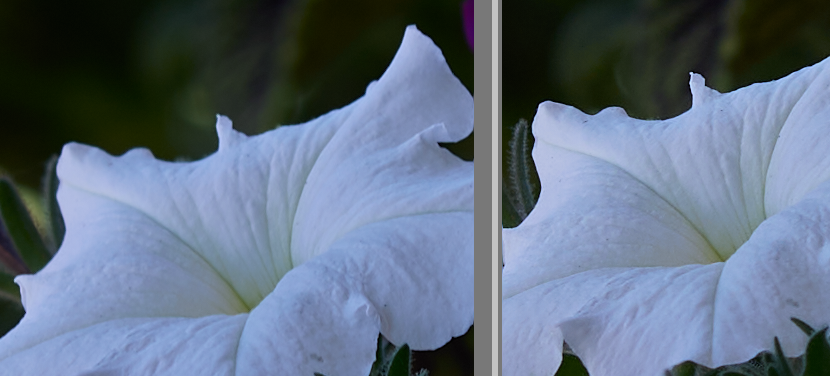
So, I decided to compare my S5 to my S1RII. I didn't use the most scientific/repeatable approach, but I used the same lens/focal length/aperture on both bodies (70-200 F4 @ 70mm & F5.6), used a tripod, and just pulled the S1RII back a bit so that the flower would be roughly the same size in both images when viewed 100%. Took several images of both to make sure there was some consistency shot-to-shot.

And it looks like there is a difference.

To my eyes, the S1RII rendered detail a little better - a little more microcontrast. Whether or not that means the S5 is more organic is of course a personal decision. I found that if I set the "Structure" slider in Capture One's Clarity tool to -10 (zero is the default in a range of -100 to 100) for the S1RII image it looked closer to the S5.

It's just one test and perhaps there is some factor here making the results untrustworthy, but like I said I took several exposures of the flower on both cameras and the outcome is the same. I'd not call this definitive proof, but if it's true, it is interesting. I suppose it boils down to the microlenses on the two sensors? Maybe I'll do more tests.

Here is a screenshot of both raw files at 100%. S1RII is on the right. White Balance is the same on both images, and the exposure was increased a bit on the S1RII image to get them to match.

Screenshot 2026-10-04 at 12.01.21 PM.png


Anyway, just some fun on a slow Sunday morning.
 
Are these SOOC JPEGs George, or raw files processed in something like LR?
 
Are these SOOC JPEGs George, or raw files processed in something like LR?
These are raw files processed in Capture One. I used a super small screenshot of Capture One to fit into the site upload limitations, but can upload a larger file (or make raw files available) if there is enough interest.
 
My love of the S5 has to do with how it rendered monochrome images and the ability to pull the highlights and push the shadows. When I pushed the shadows too far on the S1Rii I saw some banding. Whereas the S5 seems to work better for my purposes. I have also learned that the resolution is not that important. I usually use a Tiffen Black Diffusion FX or a Tiffen Digital Diffusion FX filter on the lenses to cut down on the sharpness (but still keep the original “grain”). The GFX resolution is nice for detailed landscapes, but for me it’s more about how the 35-70mm shot at 35mm-40mm looks compared to a 28mm +/- wide angle lens on full frame. The GFX seems more 3 dimensional to me. See latest 3 posts taken with the GFX here: https://www.instagram.com/erikannis?stkn=ZWh6NDAxem55em9k&utm_source=qr
 
My love of the S5 has to do with how it rendered monochrome images and the ability to pull the highlights and push the shadows. When I pushed the shadows too far on the S1Rii I saw some banding. Whereas the S5 seems to work better for my purposes. I have also learned that the resolution is not that important. I usually use a Tiffen Black Diffusion FX or a Tiffen Digital Diffusion FX filter on the lenses to cut down on the sharpness (but still keep the original “grain”). The GFX resolution is nice for detailed landscapes, but for me it’s more about how the 35-70mm shot at 35mm-40mm looks compared to a 28mm +/- wide angle lens on full frame. The GFX seems more 3 dimensional to me. See latest 3 posts taken with the GFX here: https://www.instagram.com/erikannis?stkn=ZWh6NDAxem55em9k&utm_source=qr
Interesting, thanks for the explanation. And, nice set of images!

Do you find that the GFX50 responds better to shadow lifting than the S1RII?
 
Last edited:
Interesting, thanks for the explanation. And, nice set of images!

Do you find that the GFX50 responds better to shadow lifting than the S1RII?
Yes, the GFX 50s and 50s2 are excellent for lifting shadows. I try to shoot dark to protect the highlights and lift the shadows.
 
Yes, the GFX 50s and 50s2 are excellent for lifting shadows.
When Panasonic moved from the S5 to the S5II it was often reported the dynamic range was somewhat reduced, and the speculation - this was because of moving to phase detect autofocus, and adding the phase detect pixels to the sensor. Fujifilm GFX 50s cameras have contrast focus, not phase detect focus. But the newer GFX 100S series cameras do have phase detect autofocus, with all those added pixels, but are reported to have more dynamic range, by a stop or so, than the 50s. Off hand it seems Fuji may have a better handle on this than Panasonic. That said the Panasonic S1ii with its dual ISO dynamic boost is in the same ball park as the GFX 100S. If I get a chance I'll try really pushing shadows and looking at details with the S1ii.
 
The algorithm suggested this video:


It is not exactly the Lumix S5D, but it could be interesting. I think he is using the Sigma Art 24-70mm f/2.8 DG DN, but I am not 100% sure.

Here is the sumnary from Gemini AI:

The video titled "Leica SL2-S 24 MP vs 96 MP Multishot vs Hasselblad X2D 100 MP", by the channel O T Schubert, provides a practical comparison of image quality, level of detail, and the real differences between three high-resolution photography options:

-Leica SL2-S in Native Mode (24 MP): Its standard full-frame resolution.

-Leica SL2-S in Multishot Mode (96 MP): A pixel-shift technique that combines multiple exposures into a single high-resolution image.

-Hasselblad X2D (100 MP Native): A medium-format camera featuring a large sensor and a true resolution of 100 megapixels.

Key points from the comparison:

Detail and Sharpness: Real photographic samples are analyzed to see whether the 96 MP generated by Leica's Multishot mode can surpass the detail of its native 24 MP and whether it can compete with or approach the true 100 MP of the Hasselblad X2D medium-format system.

Technical Limitations: The drawbacks of using Multishot mode are discussed (such as the requirement for the scene to be completely static, since movement from elements like wind or people ruins the combined shot).

Real-World Practical Use: An evaluation is made on whether these extreme resolution differences are truly noticeable or necessary depending on the final use of the images (social media, 4K YouTube videos, family photo albums, or large-format wall prints).
 
Last edited:
The algorithm suggested this video:


It is not exactly the Lumix S5D, but it could be interesting. I think he is using the Sigma Art 24-70mm f/2.8 DG DN, but I am not 100% sure.

Here is the sumnary from Gemini AI:

The video titled "Leica SL2-S 24 MP vs 96 MP Multishot vs Hasselblad X2D 100 MP", by the channel O T Schubert, provides a practical comparison of image quality, level of detail, and the real differences between three high-resolution photography options:

-Leica SL2-S in Native Mode (24 MP): Its standard full-frame resolution.

-Leica SL2-S in Multishot Mode (96 MP): A pixel-shift technique that combines multiple exposures into a single high-resolution image.

-Hasselblad X2D (100 MP Native): A medium-format camera featuring a large sensor and a true resolution of 100 megapixels.

Key points from the comparison:

Detail and Sharpness: Real photographic samples are analyzed to see whether the 96 MP generated by Leica's Multishot mode can surpass the detail of its native 24 MP and whether it can compete with or approach the true 100 MP of the Hasselblad X2D medium-format system.

Technical Limitations: The drawbacks of using Multishot mode are discussed (such as the requirement for the scene to be completely static, since movement from elements like wind or people ruins the combined shot).

Real-World Practical Use: An evaluation is made on whether these extreme resolution differences are truly noticeable or necessary depending on the final use of the images (social media, 4K YouTube videos, family photo albums, or large-format wall prints).

In the comments of the video some people say that he should use a Leica APO lens... I think that the Sigma 24-70mm f/2.8 is an excellent lens...

Here the results of his comparison:

1. Fine Detail and Micro-Contrast
Superiority of Native 100 MP: The Hasselblad X2D (100 MP medium format) delivers superior sharpness and fine-texture resolution compared to the pixel-shift composite file. The real resolution of the larger sensor captures organic nuances and micro-contrast that the digital Multishot process cannot fully replicate.
Multishot Improvement over 24 MP: Although the Leica SL2-S's 96 MP mode provides a substantial leap in detail compared to its standard 24 MP native file (also eliminating Bayer demosaicing artifacts by sampling full color per pixel), it remains a step behind true native 100 MP in optical performance and absolute resolution.

2. Scene Behavior (Artifacts and Motion)
Multishot Vulnerability: The 96 MP composite in the Leica relies on multiple consecutive exposures. Any movement within the scene (wind blowing through foliage, running water, moving people, or subtle camera vibration) introduces ghosting artifacts or localized motion blur.
Consistency of the 100 MP Sensor: The native 100 MP sensor on the Hasselblad captures the entire scene in a single exposure, guaranteeing uniform sharpness across the frame without requiring perfect environmental stillness.

3. Practical Utility and Final Viewing
At 100% Crop (Pixel Peeping): When zooming in to 100% or 200% on a monitor, the advantage of the Hasselblad X2D is clearly noticeable.
In the Real World (Prints and Displays): For the vast majority of applications (digital publications, web galleries, social media, or even standard-to-medium-sized fine art prints), the differences are virtually imperceptible to the naked eye. The resolution boost from 24 MP up to 96 MP in Multishot mode is already more than sufficient for large-scale enlargements, significantly narrowing the practical gap with 100 MP medium format.

In Summary: The Hasselblad’s native 100 MP medium-format sensor still wins in technical fidelity, edge performance, and usability free from motion restrictions. However, for static tripod-based shots, the Leica's 96 MP Multishot mode performs admirably, offering a viable ultra-high-resolution alternative without needing a dedicated medium-format system.
 
Last edited:
In the comments of the video some people say that he should use a Leica APO lens... I think that the Sigma 24-70mm f/2.8 is an excellent lens...

Here the results of his comparison:

1. Fine Detail and Micro-Contrast
Superiority of Native 100 MP: The Hasselblad X2D (100 MP medium format) delivers superior sharpness and fine-texture resolution compared to the pixel-shift composite file. The real resolution of the larger sensor captures organic nuances and micro-contrast that the digital Multishot process cannot fully replicate.
Multishot Improvement over 24 MP: Although the Leica SL2-S's 96 MP mode provides a substantial leap in detail compared to its standard 24 MP native file (also eliminating Bayer demosaicing artifacts by sampling full color per pixel), it remains a step behind true native 100 MP in optical performance and absolute resolution.

2. Scene Behavior (Artifacts and Motion)
Multishot Vulnerability: The 96 MP composite in the Leica relies on multiple consecutive exposures. Any movement within the scene (wind blowing through foliage, running water, moving people, or subtle camera vibration) introduces ghosting artifacts or localized motion blur.
Consistency of the 100 MP Sensor: The native 100 MP sensor on the Hasselblad captures the entire scene in a single exposure, guaranteeing uniform sharpness across the frame without requiring perfect environmental stillness.

3. Practical Utility and Final Viewing
At 100% Crop (Pixel Peeping): When zooming in to 100% or 200% on a monitor, the advantage of the Hasselblad X2D is clearly noticeable.
In the Real World (Prints and Displays): For the vast majority of applications (digital publications, web galleries, social media, or even standard-to-medium-sized fine art prints), the differences are virtually imperceptible to the naked eye. The resolution boost from 24 MP up to 96 MP in Multishot mode is already more than sufficient for large-scale enlargements, significantly narrowing the practical gap with 100 MP medium format.

In Summary: The Hasselblad’s native 100 MP medium-format sensor still wins in technical fidelity, edge performance, and usability free from motion restrictions. However, for static tripod-based shots, the Leica's 96 MP Multishot mode performs admirably, offering a viable ultra-high-resolution alternative without needing a dedicated medium-format system.
Anyway, I find that this is not the best landscape or scene to do such comparison, because the grass, plants and trees can move if there is a bit of wind... something more static like a bridge or a house could be better...
 
Back
Top